Army
The TommyknockersArmy is the federal force that enters Haven after the town’s transformation and the disaster in Big Injun Woods. Its intervention ends the Tommyknockers’ control of the town, but it also brings lethal force, a cordon, and the transfer of the surviving residents to a secret government installation, where they are studied until they die.
Arrival and military control
By nightfall after the fire, National Guard troops had sealed Haven off from the outside world, with those stationed downwind wearing oxygen equipment. The Army’s later entry thus took place within an already established perimeter and amid reports that the air around the town was lethal. The danger was not confined to the town’s residents: officers Torgeson and Weems escaped on foot, sharing the oxygen in their final flat-pack as they walked out toward Troy. Their account became the first official report of events in Haven, arriving after many unofficial warnings about the air and sightings of an enormous object rising from the smoke in Big Injun Woods.
When Army forces finally broke into Haven later that week, the town had become a hazardous and isolated space rather than an ordinary community to which the troops could simply return. The narrative compares their entry to burglars forcing their way into a strong safe: a forceful breach into a place whose conditions were unfamiliar and dangerous. For the military, the residents were simultaneously a potential threat and people unable to survive beyond the altered environment within Haven.
Fighting the transformed residents
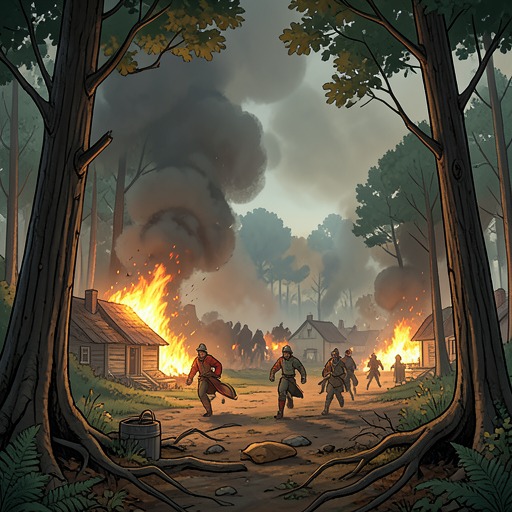
The invasion quickly became lethal. On its first day, scared soldiers shot down more than a dozen Tommyknockers while pursuing them from house to house. The soldiers were mostly young, and the narrative shows their fear giving way to a grim, escalating ease: by afternoon, some were treating the pursuit as a game. Two dozen more residents were killed before Army doctors and Pentagon scientists understood that the air outside Haven was poisonous to the transformed people. The mismatch between the invaders’ inability to breathe Haven’s air and the residents’ inability to breathe the outside air underlines how little either side understood the conditions governing the other.
The violence is illustrated by Justin Hurd’s attack on an Army sergeant with a child’s Daisy air rifle that emitted green fire. The sergeant was killed; a frightened soldier in an armored personnel carrier then fired a .50-caliber weapon at Justin, killing him. A major ordered the weapon retrieved carefully and warned the soldiers not to point it at anyone. That command came after the weapon had already demonstrated its danger and after the encounter had exposed how panic, unfamiliar devices, and military firepower could turn a street-level confrontation into rapid mutual destruction.
Capture, research, and deaths
After the first day, roughly forty Tommyknockers remained. Most were described as insane, while those who were not would not speak. The Army confined them in a makeshift stockade near the town square, below and to the right of the town hall whose tower had been destroyed. Fourteen more died during the week they were held there. The stockade turned the survivors into a guarded population, while the town itself remained a place of environmental danger and military control.
Army personnel and government scientists also investigated the altered air and the machine that produced it. They replaced the machine’s failing batteries and studied its operation; as Bobbi had anticipated, the technical principles were grasped quickly and drew intense interest from laboratories at MIT, Cal Tech, Bell Labs, and the Shop in Virginia. The response therefore had two tracks: military containment of the residents and scientific extraction of knowledge from the mechanism that had changed Haven.
The twenty-six survivors were eventually flown in a controlled-environment cargo bay of a C-140 Starlifter to the Shop, a government installation in Virginia that had once been burned to the ground by a child. There they were studied and died one by one. Alice Kimball, a schoolteacher and the last survivor, died on October 31, Halloween. The transfer preserved the survivors long enough for examination, but it did not become a rescue: the institution that received them studied them until none remained.
Narrative significance
Army’s arrival converts Haven’s local catastrophe into a national operation involving a sealed perimeter, specialized breathing equipment, armed incursions, and secret research. Its personnel confront a danger they initially misread, and that failure has immediate consequences for the residents: the transformed people are pursued and killed before the lethal effect of outside air is understood. The account does not present the Army as a single-minded actor with one motive; it distinguishes frightened individual soldiers, officers issuing commands, medical and scientific personnel, and the wider government research apparatus.
The aftermath exposes the cost of treating the residents principally as a security problem and a scientific object. The survivors are confined, transported under controlled conditions, and examined, yet their inability to live in ordinary outside air makes containment inseparable from their deaths. Army ends the town’s period of isolation by force, but the final fate of the Tommyknockers makes that intervention an extension of the disaster rather than its resolution.